
Everyone tells you that salespeople
need to ask more questions.…But no one tells you how.
(without sounding like an interrogator for the fraud division 🥹)
You’re in Sales.
Asking good questions is your job.
But what happens when the Buyer gives you an answer that sounds… fine?(and also like they’ve told 3 other sales people the same thing.)
Do you ask a clarifying question?Do you move on to a new subject?Do you start presenting a response?
You don’t want to accidentally turn a conversation into an interrogation…
Yeah. See? Asking questions in Sales is harder than people make it sound.

So why does it feel so hard sometimes?

You were never shown a conversation model that naturally worked.

I'm Jennifer Krueger, founder of The Curious Salesperson. I’m sharing with you the conversation model I wish I knew 20 years ago when I started my sales career. My sales success has been built on warm brave conversations.
I took what worked for me, and combined it with psychology research and emotional intelligence frameworks so you can lead meetings and phone calls with a powerful connectivity your competitors can’t touch. It’s called The Step-Ladder Questioning Technique.
The Step-Ladder Questioning Technique
Learn how to step down the rungs of your Buyer’s mental ladder, so you can get the nugget of what they want and need.
In business conversations, the salesperson and the buyer speak from the top of their own mental step-ladders. That’s where surface conversation lives: the business-speak, the generic version, the assumptions neither of you has said out loud.
The Step-Ladder Technique gives you a simple way to figure out what’s underneath the first answer your Buyer gives you.
Because the first answer is very often not the whole answer.
If you do this right…you have warmer, more professional, nuanced conversations that help you understand your Buyer’s business and their motivations in a deeper way.
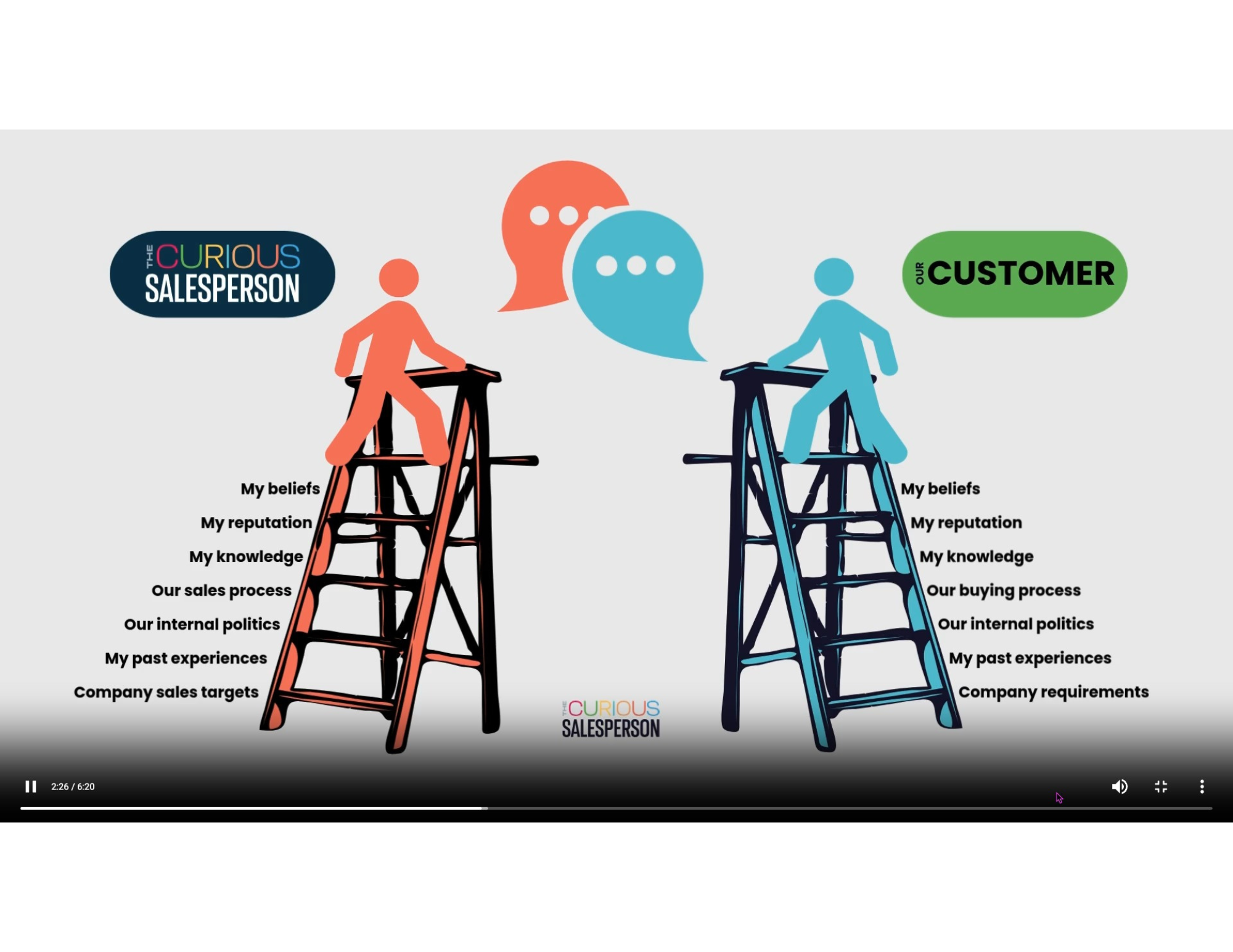
Two mental ladders. One sales conversation.
What it’s worth in a real pipeline
“I thought I had all the information, but following Jennifer’s model I clarified their answer about future load capacity and got a $32,000 sale from a client I’d been chasing for a while.”
Jeff O. · Elevator Sales
You want your conversations to be:

Put a conversation coach in your pocket.
Have Better Conversations Now. $47 →What changes when you finally have a model
for asking great questions…naturally
Your Buyer opens up. They tell you things they’ve never told another salesperson. You actually hear the whole answer, then wait, instead of rushing to fill the silence.
You always know where to dig. You sort their response and cut through the rehearsed corporate-speak, so nothing important slips past you.
They feel understood, not sold at. Your Buyer talks themselves toward the solution, because you dug into what they actually meant instead of pitching at them.
Your proposals land. They’re built on what your Buyer actually told you, not what you assumed from their first answer.
You course-correct before it gets expensive. “You’d lose functionality there; tell me more about what you’re thinking.” You catch the mismatch in the meeting, not the proposal review.
You stop dreading the pause. Ask, breathe, and let it land. You feel warm, professional, and energized instead of anxious about pushing too hard.
Step-Ladder Questioning Technique is the “How-to-Ask-Questions” model that you never knew you needed.
This is how you have better conversations that deepen relationships — allowing you to sell faster AND feel warm, professional, and energized.
Learn The Step-Ladder Questioning Technique
Four audio modules. One complete technique.
Listen on your commute, between calls, or on the way to your next meeting. $47, one time.
🎧 GET THE AUDIO COURSE · INSTANT ACCESS →A Mental Model for Better Conversations
The two-ladder image, and why most sales meetings stay frustratingly surface-level.
Stop Layering. Create Space.
Why salespeople testify instead of listen, and the three-word reset that changes everything.
Dig Down. Dig Deeper.
How to unpack your Buyer's answer one part at a time until you reach what they actually mean.
Mini-Summaries and Paraphrasing
The trust-building move almost no salesperson uses correctly. You're about to.
One technique. Every conversation you’re already having.
- ✓Discovery Calls
- ✓Second and third meetings
- ✓Demos
- ✓Proposal reviews
- ✓Negotiations
- ✓Account reviews
- ✓Renewals
- ✓Conversations with your own manager

What the research actually says
The research doesn’t say top performers ask better questions than you.
It says they ask them in a different shape... and they keep asking long after everyone else has stopped.
Top performers ask
more questions than average reps.
And they spread them across the whole meeting. Average reps front-load their questions early, then go quiet. The sweet spot sits around 11 to 14 — push past that and it starts to feel like an interrogation.
Sales Insights Lab, ~24,000 sales conversations · Gong Labs, 519,000 B2B calls
Top performers get
more back-and-forth in presentations.
They also create 78% more back-and-forth. The conversation keeps changing sides instead of quietly turning into your monologue.
Sales Insights Lab, ~24,000 sales conversations
Skilled negotiators spend
of everything they do asking questions. Average negotiators spend 9.6%.
They also test understanding and summarise back roughly twice as often — which is exactly the move in Module 4.
Rackham & Carlisle, The Effective Negotiator
🧠And one from outside sales entirely: Harvard researchers found that asking questions — especially follow-up questions, the kind that dig into the answer you just got — measurably increases how much people like you.
Huang, Yeomans, Brooks, Minson & Gino, Journal of Personality and Social Psychology, 2017
That isn’t talent. That’s a technique.

100% Risk-Free. Money-Back Guarantee.
If you don't think this audio course is worth every penny, I'll get on a quick call with you, coach you, and you still get your money back.
We love salespeople too much at The Curious Salesperson to mess you around.
You Were Made to Sell Better.™
Maybe you’ve already bought Discovery Call Breakthrough. YES!! And thank you.
Now here’s the challenge.
When you realize the mistakes you’re making in your Discovery Calls, you realize… “Shoooot. I’m doing these things in my regular client meetings too.”
I know. I’m #SorryNotSorry. I’ve been listening to dozens of salespeople from multiple industries, various experience levels, for 15 years, and everyone overtalks and underlistens. We all miss the nuance sometimes…
And those gold nugget moments are where real human connections (and long-term sales relationships) are created.
That’s why I used my work in the Science of Emotional Intelligence training that I do, plus research from psychology, sociology, and business communication experts, to create The Step-Ladder Questioning Technique.
Salespeople needed a way to ask great, often simple questions… and then follow up on their Buyer’s responses.
I’ve worked with sales teams across manufacturing, pharma, engineering and professional services — and I know the Step-Ladder Questioning Technique will work for you too. Lead powerful conversations built on emotional intelligence, psychology, and 3.5 years of sales research.
Get the Step-Ladder Questioning TechniqueFrequently Asked Questions
What is the Step-Ladder Questioning Technique?
A conversation model for salespeople. You step down the rungs of your Buyer’s mental ladder, past the rehearsed corporate-speak, to reach what they actually want and need. Four short audio modules, built on emotional intelligence and 3.5 years of sales research.
What are the best questions to ask in a sales conversation?
Open questions, then followed up. Top performers don’t just ask more questions; they dig into the answer they just got instead of rushing to the next one.
How do I ask better follow-up questions without sounding like an interrogator?
Slow down and create space. Paraphrase what you heard, then let a short pause do the work. It feels warm and professional, not like a cross-examination.
How many questions should I ask in a meeting?
The research points to a sweet spot around 11 to 14 questions, spread across the whole meeting rather than front-loaded.
Arrive at your next meeting
an even better salesperson. ✨
Four audio modules. One mental model. A completely different way of seeing the sales conversation, starting today.